
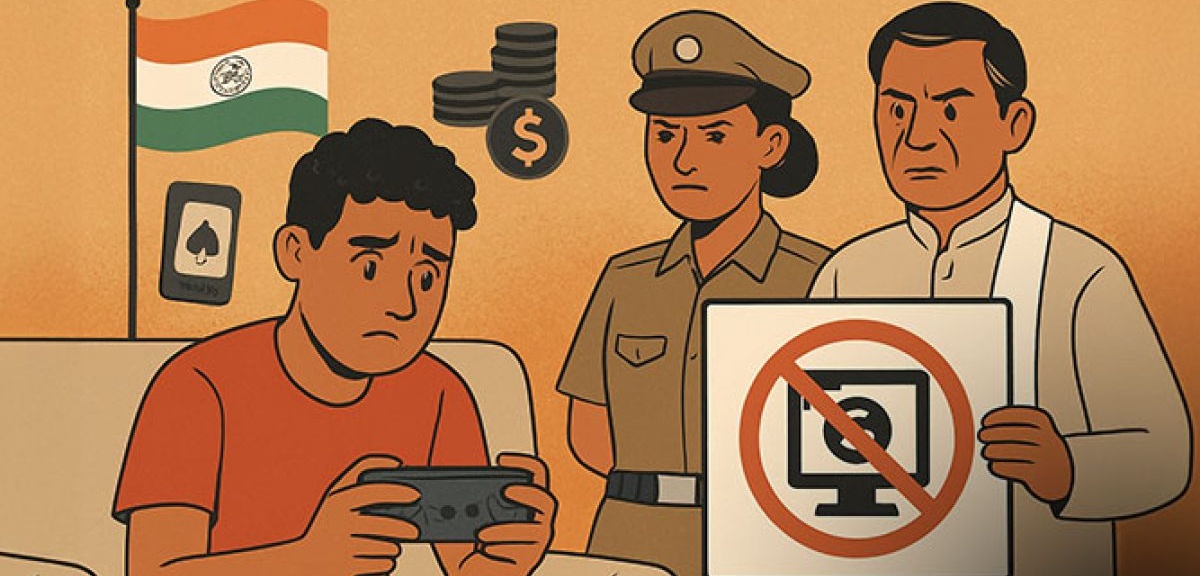
India ‘ s bill to ban online lottery has already subverted this multi-billion-dollar industry, provoking a shock in Indian sports and forcing millions of players to turn to offshore platforms. While the bill aims at curbing gambling addiction and financial harm, critics point out that it would instead further push gambling activities towards unregulated offshore markets.
Last month, the Indian Parliament passed the Online Game Promotion and Regulation Act 2025, which prohibits the provision of online game services and the promotion of such platforms. This is a result of the massive loss of property caused by online lottery, which, according to the Government of India, approximately 450 million people (or nearly one third of the total Indian population) loses approximately $2.3 billion a year on the Internet. The new Act provides for a rather severe penalty for genuine gold games, with offenders facing up to five years of imprisonment, and banks and payment agencies not being allowed to deal with related cash transactions. Ashwini Vaishnaw, Minister of Electronics and Technology of India, stressed that the distinction between electronic competition and lottery was at the heart of the bill, stating that it distinguished between “the use of false promises of profit to exploit lottery, fantasy sports and genuine gold games” and legitimate online competition. Proponents see the ban as a necessary response to the increase in gambling addiction, economic hardship and suicide. Ashwini Vaishnaw warns that “the middle class will lose all savings” and points to the tragedy of a growing number of families falling apart as a result of Internet games.

Despite pressure, the gamblers did not stop. As domestic operators in India closed down, many turned to unregulated offshore websites through the Virtual Private Network (VPN) and proxy credit cards. Advertising practitioner and senior dream sports player Adarsh Sharma predicted that Indians would “commit an explosion of growth” in overseas websites after they had adapted to the restrictions. In an interview with Agence France-Presse, Adarsh Sharma explained that: “A habit can’t be stopped once it’s developed, it’s addictive, and the player always finds a way to gamble”. An anonymous player said it was inevitable to move abroad: “We’ve had experience, we’ll get back into the business.” Analysts have warned that this trend may exacerbate the problem that the law is trying to address — the fact that offshore platforms are not subject to Indian jurisdiction and lack consumer protection. At the same time, the ban has had a severe impact on the dream sports industry in India, which was valued at nearly Pound1.8 billion prior to remediation. The largest Indian dream sports operator, Dream 11, with 260 million users, has terminated all cash competitions and turned to non-monetary incentives such as electronics, automobiles and home electricity. The company quickly terminated its sponsorship agreement with the Indian Cricket Board (BCCI) worth £34 million. Dream 11 CEO Harsh Jain acknowledged that the sudden enactment of the bill had caught the whole industry by surprise: “The whole industry was caught by surprise, and Prime Minister Moody signed the legislation on Friday, which was a thunderbolt”. The Dream Platform was previously the most radical sponsor in the cricket field, contributing 40 per cent of the India Cricket Super League (IPL) advertising revenue. Experts warned that, with their roll-out, the IPL valuation could fall when media copyrights were renegotiated in 2027, and that the team and host funding would shrink.

“The Dream Platform is the most active advertising buyer for IPL and the world’s cricket world”, an analyst, Karan Taurani, points out that these companies may have shifted their focus abroad. D and P Consulting firm Santosh N. claims that his absence will directly impact the broadcaster: “It is clear that dream operators will cut their advertising expenditures because their business model is in jeopardy and has in fact been destroyed by a ban”. Such a violent shock could not have led to a judicial rebound. The Indian card player A23 filed a constitutional complaint, and policy experts noted that legislation, by destroying regulated domestic enterprises, encouraged black market operators and undermined consumer safety. “The Act fails to pass the proportionality test,” Meghna Bal, a think tank centre in Esya, has criticized “not only as a failure to protect consumers, but also as a result of the collapse of the compliance enterprise and the opening of the door to illegal off-shore gaming platforms, which cause real financial harm”. Other critics have accused the bill of being too hasty to pass, with Rohit Kumar, a Quantum Hub company, stressing that “such sudden actions undermine India’s reputation as a stable and predictable destination for investment”. Harsh Jain, while acknowledging the responsibility of the industry for failing to put in place a strict self-regulatory mechanism to protect players at an early stage and to exclude predatory operators, warned that the ban had historically fuelled the black market and that offshore companies had begun targeting Indian users through promotional activities.

India’s cyber gambling ban changed the country’s digital game and sports economy almost overnight. The dream sports industry, which had been tied to cricket sponsorship and flourished, is now uncertain. As domestic enterprises comply with the new rules and cricket agencies are prepared to respond to a reduction in sponsorship revenues, the Government maintains that this is necessary to protect vulnerable groups. However, as millions of gamblers move to offshore platforms, the game between regulation, enforcement and consumer demand is far from over.